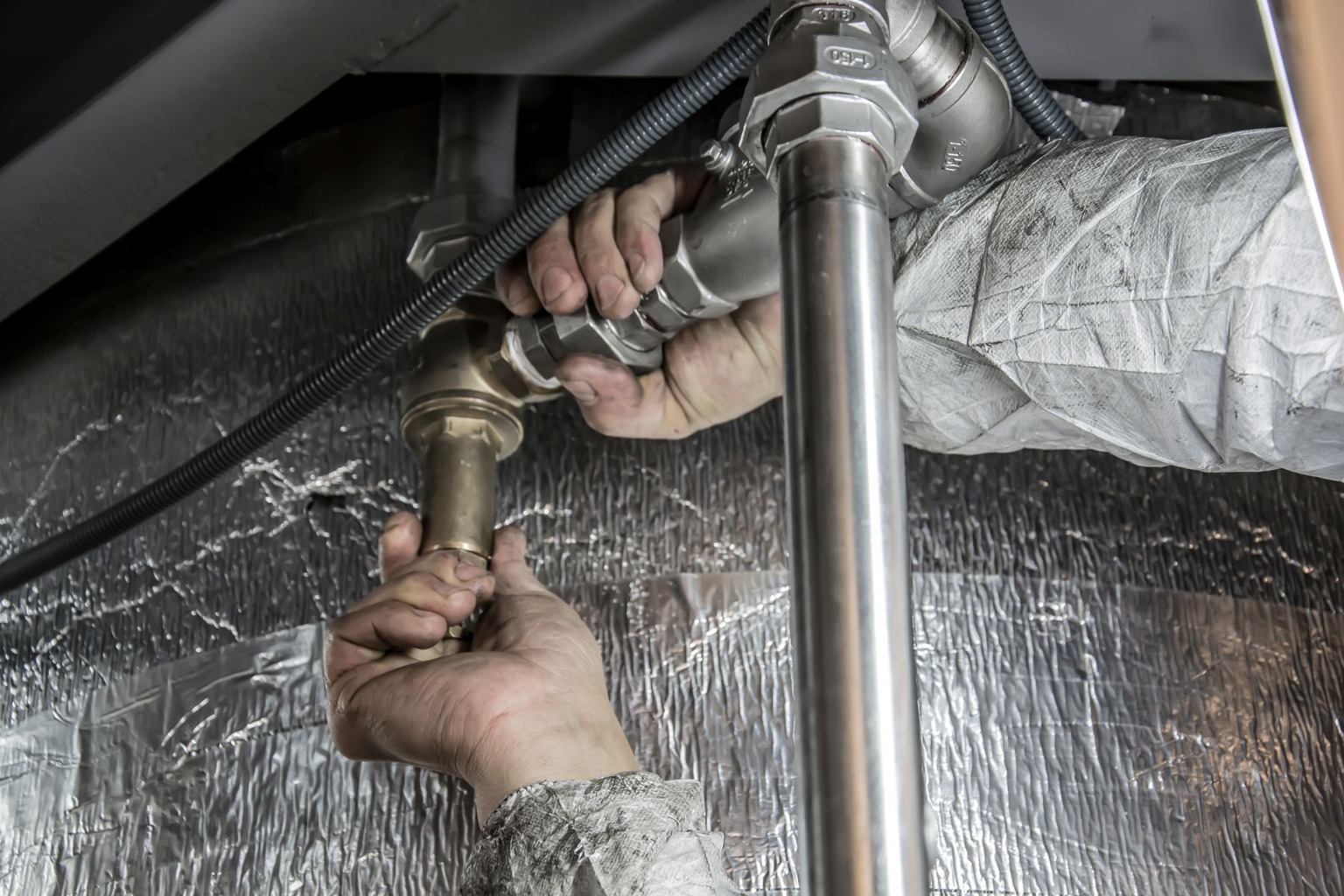
Finding Poly-B plumbing in a Penticton townhome is not a reason to panic, but it is a reason to slow down. The decision touches four different questions: what material is actually present, where it runs, who is responsible for it, and whether both the strata corporation and the buyer can obtain suitable insurance.
A quick look under one sink cannot answer all four. Townhomes can contain piping inside the strata lot, piping within boundary walls, shared distribution lines, renovated sections and original sections. The right process combines a qualified plumbing inspection, the registered strata plan, current bylaws, alteration records, meeting minutes, depreciation planning, insurance documents and written quotes. This guide is general information, not plumbing, engineering, legal, insurance, lending, appraisal or tax advice.
1. What Poly-B is—and what the label does not tell you
Poly-B is short for polybutylene, a flexible plastic water-supply piping product used in an earlier period of residential construction. The Insurance Bureau of Canada describes Poly-B as cost-effective, flexible and lightweight, while warning that it can be susceptible to breaking and that failure can lead to leaks and water damage.[1] IBC recommends professional inspection and notes that replacement may be required and that some insurers may apply exclusions.[1]
Colour alone is not a final identification. Grey flexible pipe may suggest Poly-B, but buyers should look for readable markings and have a qualified plumber confirm the material. The visible section may also be only part of the system. A renovation can leave older pipe concealed in walls, ceilings or utility chases while newer material appears at fixtures.
Do not let a statement such as “it has never leaked” replace an investigation. That statement may be accurate, but it does not establish the condition of hidden piping, fittings, prior repairs, pressure, installation quality or insurer requirements. Likewise, the presence of Poly-B does not prove that a leak is occurring today. The decision should be based on current evidence rather than reassurance or alarm.
What this means for you
Treat Poly-B as a due-diligence issue, not a verdict. Confirm the material, map the system, identify responsibility, obtain insurability answers and price the practical remedy before removing subjects.
2. How to check a Penticton townhome
Start with accessible locations: under sinks, near the water heater, in a mechanical room, at a manifold, in an unfinished basement or crawlspace, and where supply lines enter walls. Photograph markings without moving or stressing the pipe. Record whether fittings appear plastic or metal, whether there are capped or abandoned runs, and whether newer piping connects to older sections.
A home inspector can flag visible concerns, but a plumber is the appropriate professional to identify the system, assess accessible condition and scope replacement. Ask whether the inspection includes all accessible domestic hot- and cold-water distribution piping, not only the fixture connectors. If parts are concealed, ask what can and cannot be concluded without invasive access.
Visible material
Record markings, colour, fittings and every accessible location where the pipe can be seen.
System extent
Determine whether Poly-B serves one fixture, the whole unit, a radiant system or shared infrastructure.
Repair history
Look for patches, transition fittings, ceiling repairs, water staining and invoices from previous work.
Hidden limits
Ask the plumber to state which areas were inaccessible and what further investigation would require.
Keep the inspection factual. “No visible leak today” is not the same as “the system is free of risk,” and “Poly-B present” is not the same as “the entire system must be replaced tomorrow.” A useful report identifies material, locations, limitations, observed condition and recommended next steps.
3. Strata responsibility depends on boundaries and use
In B.C., responsibility does not turn only on whether a pipe is physically inside a townhome. The Strata Property Act definition of common property includes certain pipes within boundary walls, floors or ceilings, and certain facilities within a strata lot when they are intended to serve another strata lot or common property.[3] The exact strata plan, the route and purpose of the pipe, and the registered bylaws all matter.
The Province explains that a strata plan identifies the locations and boundaries of strata lots, common property and limited common property; those classifications can affect who pays for repairs.[2] A domestic supply line serving only one unit may be treated differently from a riser or line serving several homes. A bare-land strata can also allocate building and service responsibilities differently from a conventional building strata.
Review the strata plan and bylaws with the plumber’s system map. Ask council or the strata manager in writing whether similar piping has been treated as owner responsibility, strata responsibility or a coordinated project. Written history is useful, but it does not replace the legal documents. If the allocation is disputed or material to the purchase, obtain legal advice.
Do not authorize invasive work to common property on an assumption. Standard bylaws can require written strata approval for alterations to common property, and the Province notes that approval may include an agreement assigning costs to the owner.[2] A replacement plan should address access, fire stopping, drywall, common areas, working hours, contractor insurance, permits if required and restoration standards.
4. Read the strata records for a building-wide pattern
Search council minutes, AGM and SGM packages, depreciation reports, insurance summaries and financial statements for “Poly-B,” “polybutylene,” “plumbing,” “water escape,” “leak,” “repiping,” “riser,” “deductible” and “special levy.” A single repaired leak is different from a repeated pattern, and a completed repipe is different from an early discussion with no approved funding.
- Scope: Did the strata investigate one unit, several units or the whole development?
- Evidence: Is there a plumber, engineer or insurer report, or only informal discussion?
- Decision: Was a project approved, deferred, rejected or left for individual owners?
- Funding: Is money in the operating budget, contingency reserve fund or an approved special levy?
- Insurance: Did the insurer impose an exclusion, deductible change, condition or recommendation?
- Completion: Are permits, invoices, warranties and restoration records available for finished work?
Also review the seller’s alteration records. If a unit has been repiped, confirm what “complete” means. It may mean all domestic supply piping within the unit, or it may exclude shared lines, radiant heating, inaccessible sections or common-property connections. Ask for the contractor invoice and scope rather than relying on a marketing phrase.
5. Make insurance a subject-removal gate
The strata corporation’s insurance and the owner’s policy are not interchangeable. The Province states that B.C. strata corporations must carry specified property and liability insurance, while owners are strongly advised to obtain separate coverage for their own needs.[4] The owner’s policy can address contents, liability, improvements, additional living expenses and possible responsibility for losses or deductibles, subject to its terms.[4]
Give the insurance broker the exact address, occupancy, current strata insurance summary, water-damage deductible, bylaws, inspection findings and any replacement plan. Ask the broker to confirm in writing whether coverage is available, whether Poly-B is excluded, whether replacement is a condition, whether the premium or water deductible changes, and how long a binder or quote remains valid.
Ask a second question: what happens if a water loss originates in the unit? The Province warns that a strata owner may be required to pay a strata corporation’s insurance deductible and recommends reviewing owner coverage against the strata deductible.[4] Do not assume the owner’s deductible coverage automatically matches the strata’s current amount.
A mortgage approval does not prove satisfactory insurance, and an online quote is not always a binding commitment. Coordinate lender and insurer timing before subject removal. If the policy requires replacement within a period after possession, confirm the deadline, evidence required and what happens if contractor timing changes.
6. Price the replacement as a project, not a pipe count
There is no responsible universal replacement figure for a Penticton townhome. Cost depends on the number of levels and fixtures, pipe routes, finished ceilings and walls, access through common property, fire separations, chosen material, permit requirements, asbestos or other hazardous-material procedures, and the amount of drywall, paint, cabinetry or tile restoration.
Obtain written quotes that separate plumbing from access and finishing. A low plumbing quote may exclude opening and closing walls. A high all-in quote may include restoration, permits and contingency. Compare scope line by line. Confirm whether the contractor will replace every identified run, fittings and manifolds; who handles strata approvals; and who restores disturbed finishes.
Budget for temporary disruption as well as construction. Ask how long water will be off, whether the home can be occupied, how dust and contents will be protected, and whether multiple visits are expected. If several owners may repipe together, ask whether a coordinated project changes access, warranty or pricing—but do not count on group savings until the strata has a written proposal.
For offer planning, keep three numbers separate: the quoted construction cost, a contingency for unknown conditions, and any purchase-price adjustment. A seller credit or negotiated price does not guarantee that the work will cost that amount. Your decision should still work if concealed conditions expand the scope.
7. Build an offer strategy around verified facts
A buyer may choose to request seller replacement, negotiate price, retain funds through a lawyer-approved arrangement where appropriate, or accept the system with a funded post-completion plan. The right approach depends on market conditions, insurer and lender requirements, responsibility boundaries and the quality of available quotes. Do not promise a seller remedy before confirming whether the strata must approve the work.
Subject language should give enough time to inspect the plumbing, review strata documents, obtain insurance and financing confirmation, and assess quotes. Generic inspection language may not capture the documents or professional opinions needed for this issue. Your real estate professional and lawyer can help tailor conditions to the transaction.
Confirm material, extent, responsibility, insurance and written replacement scope before removing subjects.
Provide invoices, approvals and complete project scope if repiping or repairs have already been completed.
Keep shutoff access, leak response, insurance limits and strata reporting procedures current while planning upgrades.
8. Poly-B buyer checklist
- Have a qualified professional confirm whether the visible piping is Poly-B.
- Map accessible domestic lines, fittings, manifolds, radiant lines and transition points.
- Record inspection limits and identify concealed areas that remain unknown.
- Review the strata plan and bylaws for lot, boundary-wall and shared-pipe responsibilities.
- Search minutes, reports, insurance records and budgets for leaks, repiping and deductibles.
- Verify the scope of any claimed prior replacement through invoices and approvals.
- Give the current strata insurance summary and inspection findings to your broker.
- Obtain written confirmation of owner-policy availability, exclusions, conditions and deductible coverage.
- Get comparable written quotes that include access, plumbing, restoration and approvals.
- Coordinate insurance, financing, strata approval and contractor timing before subject removal.
FAQ: Poly-B in a Penticton townhome
No. Colour is a clue, not a final identification. Look for markings and have a qualified plumber confirm the material and extent.
No. Responsibility depends on the strata plan, pipe location and use, bylaws and project history. Shared and unit-only piping may be treated differently.
Insurer requirements vary. Some may offer coverage, impose conditions or exclusions, or require replacement. Obtain written confirmation for the exact property and occupancy.
There is no reliable universal price. Access, layout, finishes, approvals and restoration can matter as much as the pipe itself. Compare detailed written scopes.
Ask for invoices, scope, permits where applicable, strata approvals and warranties. Confirm whether any concealed, shared or radiant piping remained.
Sources
- Insurance Bureau of Canada — Know your home’s history and potential issues
- Province of British Columbia — Common property and limited common property
- BC Laws — Strata Property Act definitions
- Province of British Columbia — Strata insurance
- Pexels — Representative plumbing photograph by Anıl Karakaya
Want to keep going?
Get the South Okanagan Townhome Buyer’s Guide (Free)
Instant download link is emailed to you. Clear checklists, strata fee basics, and the questions buyers forget to ask.
No spam. Unsubscribe anytime.