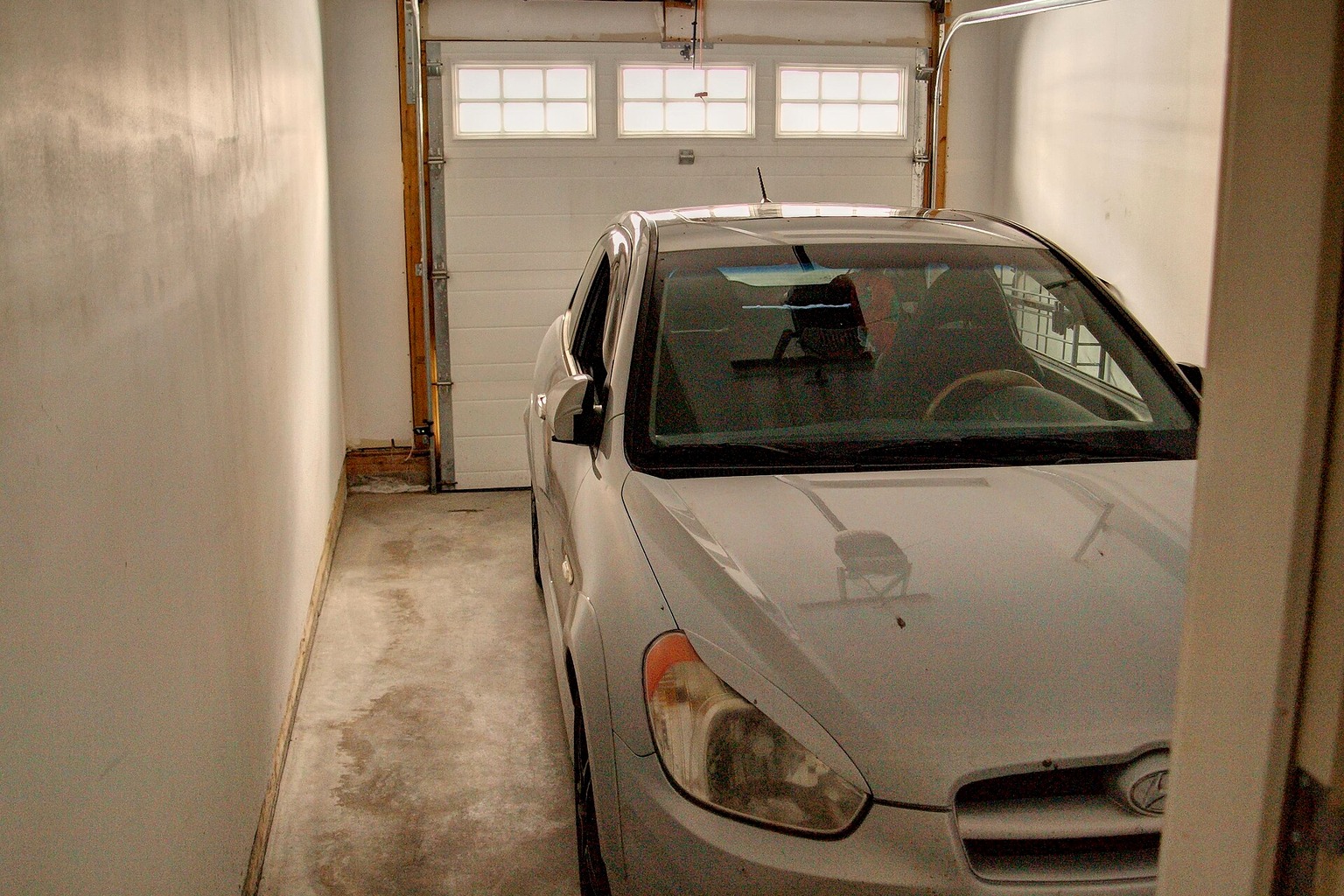
A garage door, numbered stall or “two parking spaces” in a listing does not by itself tell a Penticton townhome buyer what is owned, what may be used exclusively, what can be changed, or whether an electric vehicle can be charged there. Parking is both a physical feature and a bundle of legal, operational and electrical questions. Confirm both before removing subjects.
Start with the parking right, not the listing adjective
“Attached garage,” “carport,” “designated stall,” “secure parking” and “visitor parking” describe different things. Even two homes in the same development can have different rights if stalls were assigned differently, if one garage falls inside a strata-lot boundary, or if an owner has only a permission to use common property. Marketing copy is a starting point, not proof.
Ask for the registered strata plan and current title material early. Locate the unit boundary, garage, driveway, stall and any storage area. Then compare the plan with the Form B information certificate, bylaws, rules, minutes, parking maps, allocation records and any separate lease or licence. If the physical number on a stall differs from the documents, treat that as an issue to resolve in writing before relying on it.
Will your vehicle fit?
Measure clear width, length and height with the door, shelving, posts, curbs and turning path included. Test the actual stall with the vehicle when permission is available.
What is the right?
Identify whether the area is part of the strata lot, limited common property, common property used by permission, or governed by another recorded arrangement.
Four ways a parking space may be connected to a townhome
1. Inside the strata lot
A garage may fall within the registered boundaries of the strata lot. That does not mean the owner can alter every wall, door, electrical component or exterior surface. Bylaws can allocate repair responsibilities and require approval for alterations, while wiring, structure, exterior finishes or shared systems may involve common property. Read the boundaries and responsibility clauses together.
2. Limited common property
A stall or driveway can be common property designated for the exclusive use of one or more strata lots. The right is stronger and more visible than a casual parking practice, but the area remains common property. Maintenance, repairs, insurance, alterations and costs can therefore be divided by the Act, regulations and bylaws rather than by who parks there each day.
3. Common property used by permission or special privilege
British Columbia’s Strata Property Act allows a strata corporation to give an owner or tenant permission for exclusive use of common property that is not limited common property. The permission may have conditions, may be renewed, and may be cancelled on reasonable notice. The ordinary maximum period is one year, subject to a longer prescribed period for a qualifying class of EV-equipped parking stall.[1]
4. A separate lease, licence or other arrangement
Some developments use additional agreements, particularly where parking is managed through a separate parcel, commercial component or owner-developer arrangement. Do not assume such a right transfers automatically with a sale. Have the buyer’s lawyer or notary review the instrument, transfer process, term, fees and termination provisions.
What this means for you: Write the exact parking right into your due-diligence notes. “One stall” is incomplete. Record the stall number, legal classification, transferability, current assignment, cost, alteration limits and supporting document.
Bylaws and rules can change how useful the space is
A buyer may legally have a parking right yet find that the intended use conflicts with the community’s bylaws or rules. Look for restrictions on commercial vehicles, recreational vehicles, motorcycles, trailers, vehicle repairs, washing, storage, oil leaks, unlicensed vehicles, garage-door appearance, shelving, bicycles, tires and use of a garage as a workshop. Also check whether garage doors must remain closed and whether a garage must remain available for vehicle parking.
Visitor stalls are usually not a substitute for an owner’s missing second space. Review time limits, permits, guest definitions and enforcement. If the household has two daily vehicles, a work truck or frequent overnight visitors, verify the real pattern rather than assuming an informal exception will continue.
Minutes help show how rules are enforced. Search for repeated towing, congestion, winter snow-storage disputes, damaged gates, garage-door replacements, security incidents, drainage complaints and owner requests for parking changes. One isolated complaint may not matter. A pattern can reveal a practical cost or lifestyle friction that the sales description misses.
Inspect the garage and route as carefully as the living room
Open and close the overhead door. Confirm remote controls, keypad operation, manual release, weather seals, tracks, springs and safety reversal. Look for staining, active moisture, damaged concrete, settlement, blocked drains, exposed wiring and signs that a vehicle has struck framing or services. Ask whether the strata corporation or owner is responsible for the door, motor, slab, exterior finish and driveway.
Measure the narrowest point, not the apparent room width. Mirrors, wall-mounted equipment and door tracks reduce clearance. A full-size pickup, roof box or mobility van may not fit a space that easily holds a compact car. Check the turning angle from the private lane, the slope at the threshold and whether another parked vehicle blocks access.
In Penticton, summer heat can make a west-facing enclosed garage hot, while winter conditions make drainage, ice and snow storage practical concerns. Confirm ventilation and any restrictions on adding insulation, a heat pump, exhaust fan or storage system. Never assume a garage can be converted into habitable space or used for a business without municipal, building-code, insurance and strata review.
EV charging: an outlet is not the same as an approved charger
A standard receptacle near a stall does not prove that regular vehicle charging is permitted, safely sized, separately metered or supported by the building’s electrical capacity. Ask who owns the circuit, what else it serves, whether charging is approved, how electricity is billed, whether load management exists, and who pays for maintenance and future replacement.
Under section 90.1 of the Strata Property Act, an owner may request approval for alterations to common property or a common asset needed to install EV charging infrastructure at a parking stall. The strata corporation may consider compatibility with existing or planned charging, electricity management, electrical capacity and current and anticipated demand. It must not unreasonably refuse a qualifying request, and it may impose reasonable written conditions.[1]
The regulation requires the request to identify the owner and strata lot, describe the infrastructure and location, identify the stall, name a qualified contractor, describe the work, and provide contractor estimates for cost and time. The prescribed decision period is three months. Equipment must carry the applicable electrical safety label or mark.[2]
Approval is not the same as free installation. Unless the parties agree otherwise, the owner is responsible for expenses associated with an owner-requested alteration. Conditions may address contractors, materials, future compatibility, liability and replacement if the strata later adopts a coordinated system.[1] A buyer should therefore ask for every approval letter, alteration agreement, permit, invoice, inspection record, warranty, billing arrangement and charger specification.
Why the electrical planning report matters
For existing non-phased strata corporations outside the regulation’s specified Lower Mainland and Capital Regional District areas, the electrical planning report deadline is December 31, 2028, unless the strata plan had fewer than five lots on December 31, 2023. New strata corporations generally have a five-year deadline, with a similar exemption for fewer than five lots.[2] Because Penticton is outside the listed specified areas, buyers should not assume every applicable local strata already has its report.
When available, the report can show current electrical capacity, existing demands, peak demand, spare capacity, anticipated future loads, practical demand reductions and possible upgrades. It is planning evidence, not a promise that an individual charger will be approved. Read it alongside minutes, budgets, depreciation planning and any EV strategy.
| EV question | Evidence to request | Why it matters |
|---|---|---|
| Is charging permitted? | Bylaws, rules and written approval | A nearby outlet alone is not authorization |
| Is the stall right secure? | Plan, Form B, allocation record or agreement | Infrastructure does not create a parking right |
| Can the system carry the load? | Electrical planning report and contractor documentation | Capacity and future demand affect feasibility |
| Who pays? | Alteration agreement, invoices and billing policy | Installation, electricity and replacement can be separate costs |
| Will it fit a future system? | Charger specification and strata EV plan | A private installation may need later modification |
Put parking due diligence into the offer process
- Identify the exact space. Record the stall or garage number and compare it with the home, listing and documents.
- Classify the right. Confirm whether it is strata lot, limited common property, common-property permission or a separate agreement.
- Review restrictions. Read bylaws, rules and recent minutes for vehicle, storage, visitor and garage-use limits.
- Test physical usability. Measure clearance and assess access, slope, door operation, drainage, lighting and security.
- Trace EV approvals. Obtain permits, contractor records, electrical documentation, approvals, billing terms and warranties.
- Price future needs. Consider a second vehicle, mobility needs, larger vehicle, charger upgrade, remote replacement and garage-door repair.
- Use professional review. Ask the lawyer or notary about the parking right, an electrician about the installation, and the insurer about vehicle charging and garage use.
Make the purchase contract fit the evidence still outstanding. Depending on the property and advice received, that may include document review, title and plan review, inspection, financing, insurance and confirmation of parking or charging arrangements. Do not remove subjects merely because a stall number appears in the listing.
Parking and garage red flags worth slowing down for
- The listing, stall number and Form B do not match.
- The seller describes a long-standing assignment but cannot produce the allocation record or agreement.
- An EV charger exists without written strata approval, permit evidence or a clear billing method.
- A receptacle is presented as “EV ready” without contractor documentation or capacity information.
- The household’s second vehicle depends on visitor parking or an informal neighbour arrangement.
- Minutes repeatedly discuss towing, blocked fire lanes, gate failures, drainage or unauthorized garage storage.
- The garage is shown as a workshop, bedroom or rental area without evidence that the use is permitted.
- The vehicle fits inside but the doors cannot open comfortably, the garage door cannot close, or the turning route is impractical.
FAQ: Penticton townhome garages, parking and EV charging
No. Confirm the registered strata-lot boundary and supporting records. A garage or stall may be part of the strata lot, limited common property, common property used by permission, or governed by another arrangement.
It depends on the legal basis of the right. A revocable common-property permission is different from a garage inside the strata lot or limited common property. Obtain legal advice on the exact documents.
Possibly, but do not assume it. Review the stall right, strata process, electrical capacity, contractor requirements, equipment certification, permits, cost allocation and future-system compatibility.
No. The Strata Property Act expressly says an owner-requested EV installation does not change anyone’s parking rights, permissions or privileges.[1]
Measure the narrowest width, usable length and lowest height, then consider mirrors, doors, shelving, posts, curbs, charger placement, garage-door tracks and the turning route.
Usually it should not be treated as permanent owner parking. Read the rules for permits, time limits, enforcement and guest eligibility before depending on it.
Authoritative sources
Want to keep going?
Get the South Okanagan Townhome Buyer’s Guide (Free)
Clear checklists, strata fee basics, and the questions buyers forget to ask.
No spam. Unsubscribe anytime.