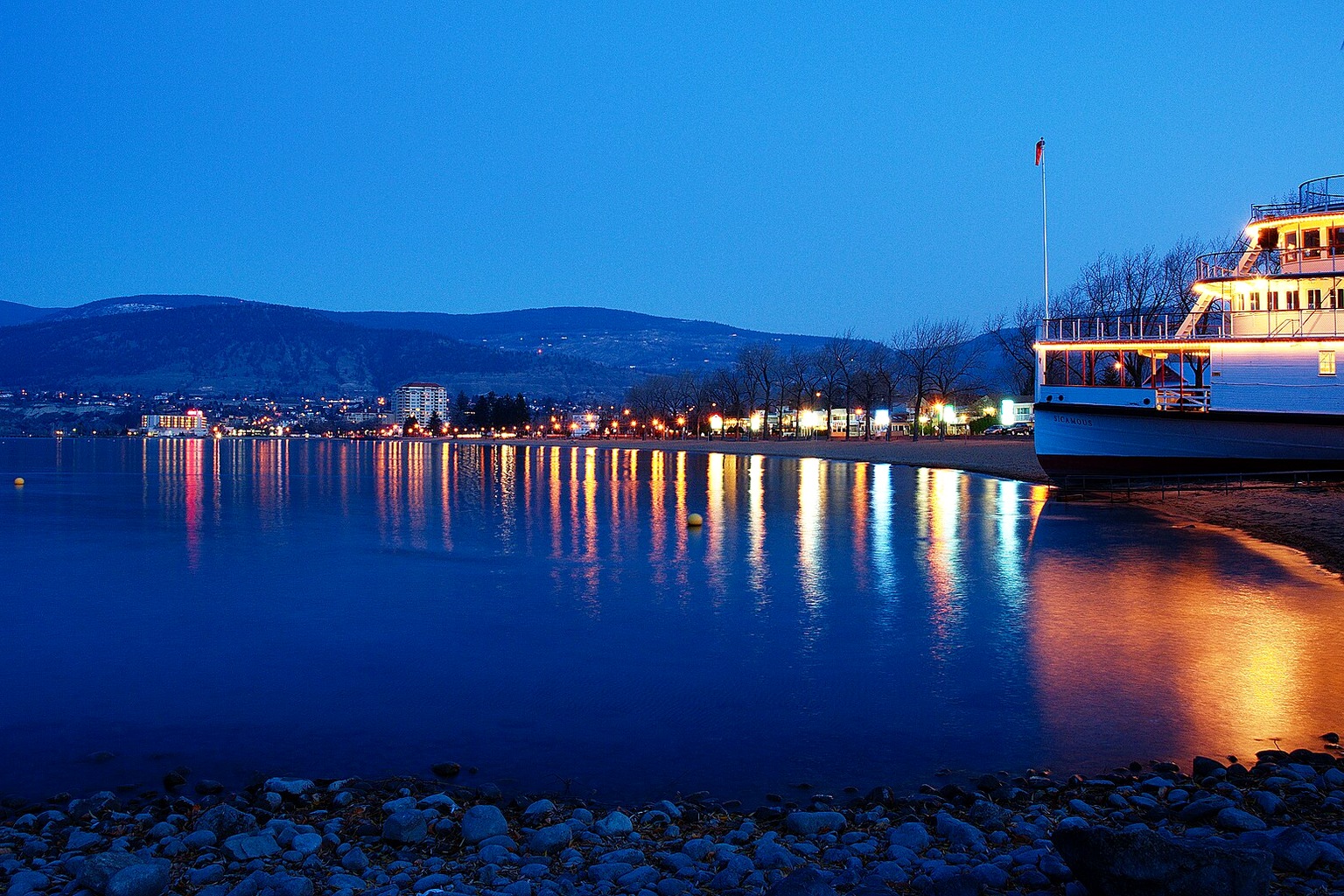
Living near Okanagan Lake can put beaches, waterfront paths and Penticton’s north-end amenities close to home. The trade-off is not that every nearby townhome has the same flood exposure. It is that buyers should investigate water from several directions: lake and creek hazards, intense rainfall, site drainage, sewer backup, groundwater, plumbing losses and the way a strata’s insurance and repair obligations divide the cost.
“Near the lake” is a lifestyle description, not a risk conclusion
Distance to the shoreline is only one clue. Two homes a similar walking distance from Okanagan Lake can differ in ground elevation, drainage route, crawlspace or basement design, retaining conditions, municipal servicing and building history. One may sit above surrounding grades while another receives runoff from a lane, roof, landscaped slope or neighbouring property. A map can flag where better questions are needed, but it cannot replace an inspection, records review, survey information or an insurer’s address-specific decision.
The City describes Penticton as being between Okanagan and Skaha lakes and says emergency risks vary by location. Its hazard guidance states that floods can happen at any time, with the most severe floods usually occurring in spring and early summer because of heavy rain and melting snow; the page also links to a local hazard map.[3] That is a reason to investigate, not a reason to label every north-end property high risk.
What can reach the site?
Review mapped hazards, nearby waterways, surface slopes, drainage infrastructure and known emergency history. Ask the City or a qualified professional what the available mapping does—and does not—show for the exact address.
How would water enter?
Inspect doors, windows, window wells, foundation penetrations, parkade ramps, garages, crawlspaces, roof drainage, patios and low points. Look for staining, efflorescence, odour, fresh patching or repeatedly replaced finishes.
Separate the water scenarios before asking about coverage
“Flood” is often used as a catch-all, but property and insurance questions become clearer when the source is specific. Overland water entering through a door is not the same event as a pressurized supply line failing inside a wall. Sewer backup, groundwater seepage, rain entering through a roof defect and a lake or creek event may be treated differently by policies, deductibles and repair responsibilities.
| Water scenario | Property evidence | Insurance question |
|---|---|---|
| Overland water | Grades, low openings, map context, past events, barriers and drainage paths | Is overland-flood coverage included, optional, excluded or limited? |
| Sewer backup | Backwater valve, plumbing history, lower fixtures and municipal servicing | Is sewer-backup coverage separate, and what deductible and limit apply? |
| Groundwater or seepage | Foundation condition, sump system, drainage, moisture readings and repairs | Are seepage or repeated-water exclusions relevant? |
| Internal water escape | Supply lines, appliances, hot-water system, fixtures and claim history | What is the strata water-damage deductible and the unit-policy limit? |
| Roof or envelope entry | Roof age, flashing, windows, balconies, membranes and maintenance records | Is the cause insured, and who maintains the failed component? |
British Columbia requires strata corporations to carry property and liability insurance, and mandatory property coverage includes specified perils such as water escape. However, the Province says overland flood damage is not a mandatory peril; a strata may purchase it as optional coverage.[1] Never turn “the building is insured” into an assumption that every water source, repair, temporary living cost or owner expense is covered.
What this means for you: Ask an insurance broker to review the actual strata policy summary and the exact address before you remove subjects. Use plain scenarios: lake or creek water, surface runoff, sewer backup, foundation seepage, sump failure and water escaping from inside the unit.
Use public hazard information correctly
Start with current City and provincial information, then confirm what the map represents: hazard extent, emergency-planning area, development-permit area, historical event or another layer. Record the map name, date and legend. A coloured area does not by itself establish whether a particular loss is insured, whether financing is available or whether a building will flood. Likewise, being outside a displayed area does not eliminate local drainage, sewer, groundwater or building-envelope risk.
Penticton’s landscape has more than lake-related considerations. The City says Penticton and Ellis creeks play a flood-protection role, that Penticton Creek was channelized after flooding damaged downtown, and that changes along Ellis Creek increased flood risk in some sections.[4] A buyer should therefore avoid a one-factor rule such as “farther from the beach means no water risk.” Trace the exact site’s relationship to lakes, creeks, grades and drainage systems.
Questions for the City or a qualified consultant
- What current hazard or development mapping applies to this legal parcel?
- Does the map show a regulatory area, a modelled event, historical information or general emergency planning?
- Are there flood-construction levels, covenants, geotechnical reports, drainage requirements or building-permit records tied to the parcel?
- Has nearby infrastructure, creek restoration, drainage or shoreline work changed since an older report was prepared?
- Would a surveyor, engineer or other specialist be needed to interpret elevation or site-specific exposure?
Read the strata file for water history and future cost
The Form B insurance summary is a starting point. The Province says that summary must be attached when a Form B is requested by an owner or prospective purchaser.[1] Obtain the complete current summary, not only the premium total. Note the named insured, policy period, insured value, exclusions, endorsements and each deductible—especially water damage, sewer backup and any overland-flood wording.
Then connect insurance to maintenance. Search several years of council and general-meeting minutes for leaks, sump alarms, foundation seepage, parkade drainage, roof or balcony work, irrigation failures, sewer odours, mould investigation, emergency restoration and claims. Read invoices, engineering reports and correspondence referenced by the minutes. A resolved one-time event is different from repeated repairs without a diagnosed cause.
Review the depreciation report, operating budget, contingency reserve fund and levy history. A property can have insurance and still expose owners to uninsured work, deductibles, premium increases and repairs below the deductible. The Province notes that a strata can pay its deductible from the contingency reserve fund or by special levy, and can recover the deductible from an owner responsible for the loss even without a finding of negligence.[1]
Physical systems worth tracing
- Roof drains, gutters, downspouts and where they discharge.
- Perimeter drainage, catch basins, sump pumps, alarms and backup power.
- Parkade or garage ramps and the lowest exterior openings.
- Irrigation lines, hose bibs and landscaping grades against walls.
- Domestic supply lines, shutoff valves, appliance hoses and hot-water equipment.
- Balconies, decks, membranes, windows and building-envelope transitions.
- The strata plan and bylaws showing which components are common property, limited common property or part of the strata lot.
The owner still needs a separate policy
Strata corporation insurance does not replace an owner’s unit policy. Provincial guidance says the corporation’s policy does not cover an owner’s personal liability, contents, additional living expenses or the cost of paying the strata corporation’s deductible.[2] It also recommends taking the strata policy summary to a knowledgeable broker so the two policies can be reviewed together.[2]
Ask for a written quote based on the exact use of the home: owner occupied, tenant occupied, seasonal or vacant for periods. Disclose renovations and betterments. Confirm the limit available for strata-deductible assessment, sewer backup, water damage, additional living expense and any optional overland-flood protection. If a lender requires coverage that the insurer will not provide, that conflict must be solved before subject removal.
Do not compare policies on premium alone. A lower price may carry a larger deductible, narrower limit, different exclusions or conditions such as maintaining heat, installing backwater protection or checking the home during an absence. Ask what evidence the insurer needs after a loss and what changes must be reported during the policy term.
Inspect for both old damage and weak prevention
A general home inspection should include moisture-sensitive areas, but a significant concern may justify a plumber, drainage contractor, building-envelope professional or engineer. The useful question is not simply whether surfaces are dry on inspection day. It is whether the building has a credible path for managing roof water, surface runoff, sewage and groundwater during adverse conditions.
Look behind stored items where practical. Test visible shutoffs and drainage equipment within the inspector’s scope. Ask for permits, warranties and invoices for waterproofing, sump work, foundation repair, flooring replacement or remediation. Fresh paint or new laminate is not evidence of a problem, but it is a reason to ask what was changed and why.
An offer-stage due-diligence sequence
- Identify the parcel and unit. Use the legal description, strata plan and civic address so every inquiry refers to the same property.
- Check public information. Save the current map, legend and date, then ask the City what the relevant layer means.
- Review the strata package. Read bylaws, Form B, insurance, minutes, budgets, financials, depreciation report, engineering material and levies together.
- Investigate water events. Request details of claims, leaks, remediation, recurring complaints and completed preventive work.
- Inspect the site and unit. Follow drainage from the roof and grounds to the lowest opening; inspect plumbing and moisture-prone areas.
- Obtain insurance in writing. Give the broker the strata summary, property address, occupancy plan and known claims or improvements.
- Confirm financing. Ensure the lender accepts the available property and owner coverage.
- Model owner exposure. Budget for unit-policy deductibles, strata-deductible assessment, uninsured repairs, temporary accommodation and a possible levy.
- Escalate unresolved issues. Use legal, insurance, engineering, inspection or municipal expertise before removing subjects.
Red flags that deserve an answer—not a guess
- The listing says “no flood risk” but provides no source or property-specific support.
- The insurer has not seen the strata policy or will not quote until after completion.
- Minutes mention repeated leaks, sump failures or remediation without a final report.
- A high water-damage deductible exceeds the owner-policy assessment limit.
- Drainage outlets, sump pumps or backwater protection cannot be located or maintained.
- Recent finishes cover lower walls or floors, but invoices and the reason for replacement are unavailable.
- The strata budget has little allowance for drainage, roof, envelope or mechanical maintenance identified in the depreciation report.
- A map screenshot is supplied without the map name, date or legend.
- The purchase only works if every future water event is assumed to be insured.
FAQ: townhomes near Okanagan Lake
No. Proximity alone is not a property-specific conclusion. Review current mapping, parcel conditions, elevation and drainage, building history, strata records and insurance for the exact address.
No. Provincial guidance says overland flooding is not a mandatory peril for strata corporations, although optional coverage may be purchased.[1]
The Province says strata corporation insurance does not cover an owner’s contents, personal liability or additional living expenses. Owners should review separate unit coverage with a broker.[2]
There is no single number. Compare each relevant strata deductible with the matching limit and deductible on the owner policy, then read the exclusions and conditions.
No. Confirm what the map shows, then combine it with site inspection, strata and municipal records, professional interpretation when needed, and an address-specific insurance quote.
Ask for the source, affected areas, repair and remediation scope, permits or professional reports, insurance outcome, deductible, preventive changes and evidence that the work was completed.
Authoritative sources
- [1] Province of British Columbia: Insurance for strata corporations
- [2] Province of British Columbia: Strata owner and tenant insurance
- [3] City of Penticton: Know the Hazards
- [4] City of Penticton: Creek Restoration
Want to keep going?
Get the South Okanagan Townhome Buyer’s Guide (Free)
Clear checklists, strata fee basics, and the questions buyers forget to ask.
No spam. Unsubscribe anytime.