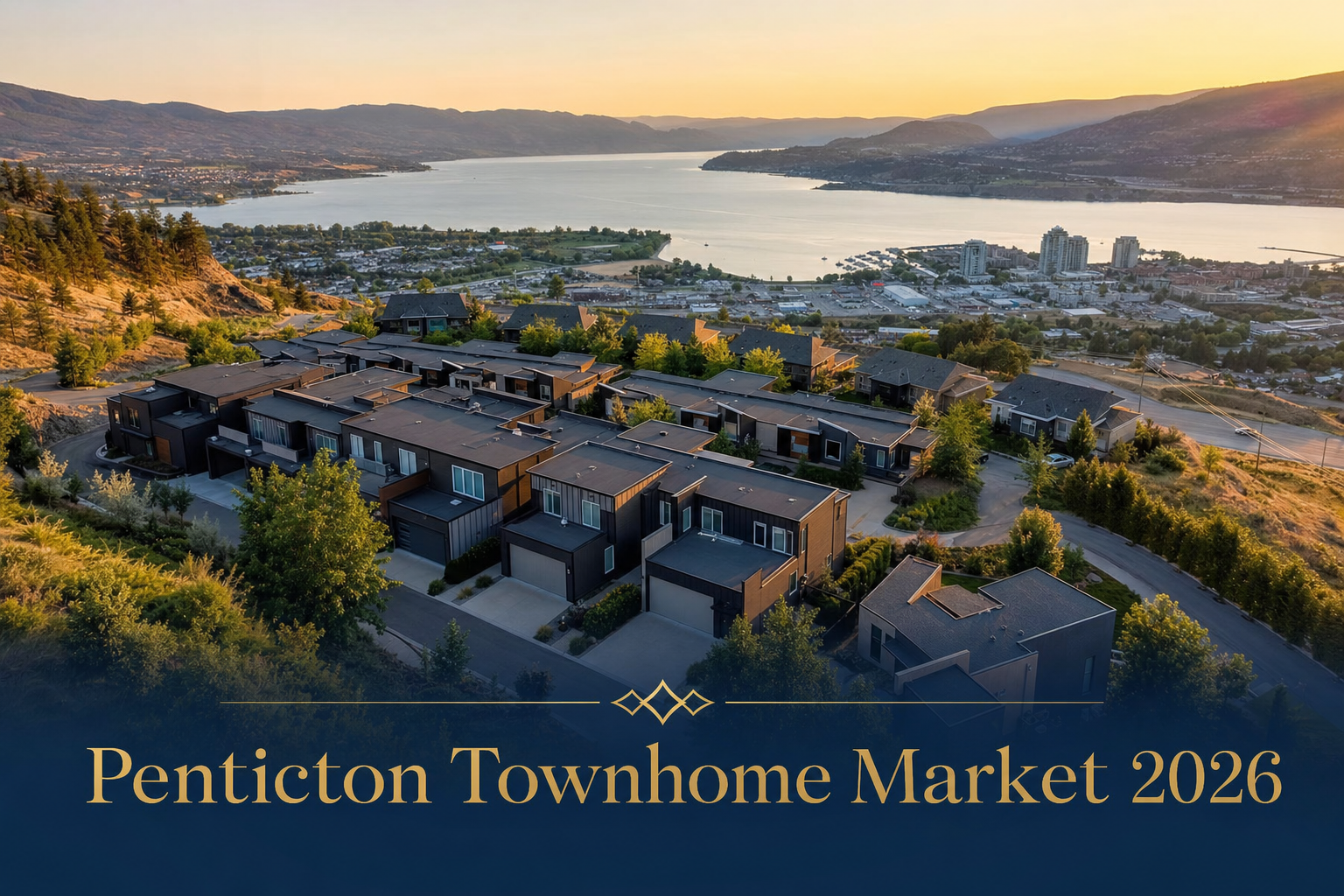
The Penticton townhome market in 2026 is a buyer’s market in transition — more choice than last year, rates that are finally cooperating, but enough competition in the right price bands to keep you sharp. Here’s what the numbers actually mean for townhome buyers right now.
Market Snapshot: Where Things Stand in 2026
After two years of compressed inventory and aggressive bidding wars, the South Okanagan real estate market has softened into something closer to balance. For townhome buyers specifically, that shift matters more than the headline numbers suggest.
Townhomes in Penticton have held their value better than single-family detached homes at the lower end of the market — largely because the townhome buyer profile (downsizers, first-timers priced out of freehold, lifestyle-first relocators) didn’t disappear when rates climbed. Demand stayed sticky. Supply stayed thin. That dynamic hasn’t fully reversed.
What this means for you: More choice than a year ago, less panic pressure — but well-priced units in desirable complexes still move quickly. The negotiating window is real, but it won’t stay open indefinitely if rates keep softening and sidelined buyers return.
Why Townhomes Are Holding Stronger Than the Broader Market
In a softening market, not all property types move the same way. Townhomes in Penticton have a few structural advantages that insulate them from the sharper corrections you see at the top of the detached market.
1. Price point draws a broader buyer pool
Townhomes typically enter the market at a lower price point than freehold detached homes, which means more buyers can qualify — especially as lenders stress-test at current rates. When the pool of qualified buyers is wider, demand stays steadier even when conditions shift.
2. Lifestyle appeal has broadened
The “lock and leave” townhome lifestyle is no longer just a retirement story. Remote workers, young families priced out of detached, and semi-retirees are all pointing to townhomes as their preferred format in the Okanagan. That’s a broader demand base than this segment had five years ago — and it’s a structural shift, not a trend.
3. New supply is constrained
Penticton’s geography — mountains, lakes, the highway corridor — makes large new townhome developments slow and expensive to approve. Existing inventory benefits from that constraint. If you buy into a well-run complex today, your resale position is reasonably protected on the supply side.
What Buyers Need to Watch for Right Now
A more balanced market doesn’t mean risk-free. There are a few dynamics worth understanding before you write an offer in 2026.
Strata fee creep is real
Inflation hit strata budgets hard in 2023–2024. Insurance premiums, maintenance contracts, and management fees all climbed. Many stratas are still catching up. Before you commit, look at the last 3 years of strata financials. If fees jumped significantly and a reserve fund study is due, factor potential increases into your monthly carry cost — not just the current fee.
Special levies: the hidden risk
If a complex deferred maintenance through the pandemic years, you may be walking into a building where a special levy is being discussed — or already approved. This is visible in strata minutes. It’s one of the most important things to read before removing your subjects. A $15,000–$40,000 special levy can materially change the economics of what looked like a reasonable deal.
Interest rate sensitivity
Rates have improved from their 2023 highs, but buyers renewing in the next 12–18 months should stress-test their budgets at a modest increase. The monthly payment difference between a current rate and a renewal rate 18 months from now is real money. Know your number before you stretch on price.
Insurance deductible exposure
Some stratas carry deductibles of $25,000–$50,000 or more per water or fire claim. If a claim originates in your unit and the strata’s deductible applies to you, that’s a significant out-of-pocket exposure. Your personal condo/townhome insurance policy can cover this — but you need to know the strata’s deductible amount before choosing your policy limits. Ask for the strata’s insurance summary during due diligence.
Bottom line: In this market, document quality beats list price. A slightly higher-priced unit in a well-run strata with healthy reserves is almost always a better long-term buy than a bargain in a complex with deferred maintenance and thin funding.
The Best Window to Buy — and What to Watch
If you’ve been waiting for “the right time” to buy a townhome in Penticton, 2026 offers something the past few years didn’t: negotiating room. Sellers who’ve been holding at 2024 prices are now adjusting. Days on market have stretched. Buyers with solid financing in place can take their time in a way that wasn’t possible in 2022 or early 2023.
That said, the window isn’t unlimited. The Bank of Canada’s rate path has shifted, and if rates continue easing into late 2026, buyers currently sitting on the sidelines will re-enter the market. More buyers plus stable-to-tightening supply is the recipe for price recovery. The buyers who move with confidence now — on the right complex, at a negotiated price — will be the ones who look smart in 2027.
The strategic play: buy the complex first, then the unit. Find a strata that’s financially sound, well-maintained, and has the lifestyle rules that match how you actually live. Then wait for the right unit in that complex to come to market. You’ll be in a position to move confidently and quickly when it does — without the rushed-decision risk that catches buyers who haven’t done the homework.
Best Areas for Townhome Buyers in Penticton Right Now
Penticton’s townhome inventory is concentrated in a few key corridors, each with a slightly different buyer profile and lifestyle trade-off.
- South Main / Skaha area: Closer to Skaha Lake, quieter summer traffic, strong family amenity access. Popular with downsizers and young families. Good long-term resale profile.
- North Penticton / Channel Parkway corridor: Easy access to downtown and the Okanagan Lake beach strip, but higher summer foot and vehicle traffic. Best for lifestyle-first buyers who want walkability and proximity to everything.
- KVR Trail corridor: Newer complexes with trail access, away from the tourist strip. Appeals strongly to outdoor-lifestyle buyers. Growing segment.
- Summerland (just north): Slightly lower price points, quieter pace, small-town feel. Worth exploring if the Penticton market feels stretched — many buyers who look here end up preferring it.
FAQ: Penticton Townhome Market 2026
Prices are slightly below 2024 peak levels — roughly 5–10% depending on the complex and unit type. The market has softened from its highs, but well-priced units in desirable complexes continue to attract multiple offers. A broad “up or down” answer misses the unit-level variation that matters most to buyers.
Closer to balanced, with a slight lean toward buyers. Inventory is up, days on market have stretched, and negotiating room exists on many listings. However, this varies significantly by complex and price band — motivated, well-priced listings still attract quick offers.
Most Penticton townhome strata fees range from $300–$550/month depending on complex age, amenities, and what’s included (water, landscaping, snow removal, etc.). Older complexes with aging infrastructure or deferred maintenance tend to run higher. Always compare the fee against the reserve fund balance — the fee alone doesn’t tell the full story.
Timing rates is notoriously difficult. What matters more is whether your monthly carry cost works at current rates and whether you can absorb a modest increase at renewal. If the numbers work now and you’ve found a well-run complex, waiting for a lower rate while prices recover may cost more than the rate savings will ever give back.
Read the minutes from the last two years and look for red flags: ongoing unresolved maintenance issues, financial shortfalls, contentious owner disputes, or insurance claim history. A healthy strata has clear communication, consistent maintenance, and a reserve fund that’s tracking with the building’s age. If the minutes are thin or missing, that’s itself a warning sign. I can walk through the key documents with you before you remove subjects.
Want to keep going?
Get the South Okanagan Townhome Buyer’s Guide (Free)
Instant download link is emailed to you. Clear checklists, strata fee basics, and the questions buyers forget to ask.
No spam. Unsubscribe anytime.